
comparison · 11 November 2026 · 12 min read
Weighing the Pros and Cons of Suburban Border Town Property
By Editorial Team

Last Updated: November 10, 2026
Quick Summary
Investing in suburban border towns offers lower purchase prices, cross-border tenant demand and possible jurisdiction arbitrage on taxes and levies. However, these gains come with limited infrastructure, thinner resale markets, slower rental uptake and higher relative operating costs, so verify title, services and infrastructure before paying.
- A suburban border town sits within two hours of a metro economy and below the urban average land price.
- Rental demand tracks transport links more than the boundary itself, so vacancy climbs where commuting is unreliable.
- Illustrative modelling shows a 4.1% net yield for a border-town unit versus 6.0% urban.
- Expect a resale period of 9 to 18 months for border-town property against 3 to 6 months urban.
- Search the title at the state land registry and confirm the survey plan before any payment.
Table of Contents
- What Counts as a Suburban Border Town for Property Investors
- The Advantages of Buying Property in Suburban Border Towns
- The Drawbacks and Risks of Suburban Border Town Investment
- How Suburban Rental Property Investment Compares to Urban Alternatives
- Land Investment Due Diligence: What to Verify Before You Pay
- Infrastructure and Property Value: The Long-Term Connection
- Property Investment Risks and Returns: Building a Realistic Model
- Choosing a Suburban Border Town Property with Pennek
- Frequently Asked Questions
What Counts as a Suburban Border Town for Property Investors
A suburban border town is a settlement on the edge of a major metropolitan area, often straddling or sitting close to a state boundary, where land is cheaper than the city core but access to city jobs remains within commuting distance.
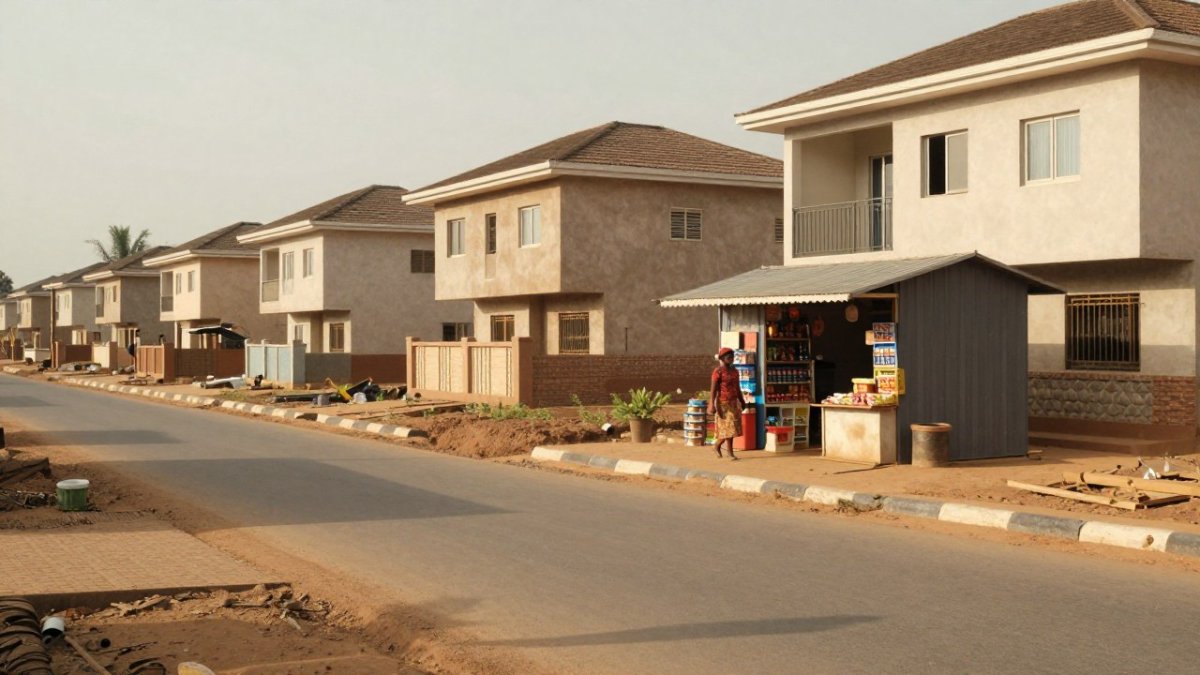
Pennek works in residential communities across Lagos and Abuja, and the question we hear most from diaspora buyers is simple: is the cheaper land outside the city centre actually a good buy?
Three features define the category:
- Proximity to a metro economy, usually under two hours of daily commuting
- A boundary line that splits tax, planning and service jurisdiction
- Land prices below the urban average, driven by lower infrastructure spend
Miss any one of these and you are looking at rural property, not a border town. The distinction changes everything about rental demand, regulation and resale.
The Advantages of Buying Property in Suburban Border Towns
The case for these locations rests on three pillars: entry cost, cross-boundary tenant supply, and jurisdiction arbitrage. All three are real, and all three come with conditions that ordinary suburb-versus-city guides never test.
Lower Purchase Prices and Wider Affordability
Land and housing on the suburban fringe typically cost less than comparable space closer to the city centre. That gap gives first-time buyers a way in without stretching to the edge of affordability, and it gives investors room to build or hold without tying up all their capital in one asset.
Affordability is not the same as value, though. A cheap plot on a road that never gets tarred is not a bargain. The price advantage only holds when the location has a credible path to services, and that path usually runs through a state or local government budget line you can inspect.
Cross-Border Employment and Tenant Demand
Border towns often sit within reach of two employment pools: the metro centre on one side and the neighbouring state's commercial activity on the other. That can widen the tenant pool beyond what a single local employer would support. A border town on the Lagos-Ogun axis, for example, can draw tenants who work in Lagos industrial estates but rent where Ogun land and rents are lower; the reverse also happens where the neighbouring side has a free trade zone, a university, or a state secretariat that anchors white-collar demand.
In practice, rental demand in these towns tracks transport links more than anything else. Where commuting is practical, a functional expressway, a bus corridor, a rail stop within reach, occupancy holds. Where it is not, vacancy rates climb and rental income disappoints. The border-town advantage is therefore not the boundary itself but the number of viable commute directions it opens. A town with one road to one job market is a suburb; a town with two roads to two job markets is a border-town opportunity.
Jurisdiction Arbitrage on Taxes, Levies and Compliance
A boundary line is also a price line for compliance. Levies, rates, development permit fees, and landlord registration requirements can differ between the two authorities that meet at the boundary.
Watch out: a lower levy on one side of the boundary is only an advantage if the services that levy funds, access roads, drainage, waste collection, actually reach the plot. Confirm the service, not just the rate.
The Drawbacks and Risks of Suburban Border Town Investment
Limited infrastructure is the defining weakness of small-town and fringe development. Research from Grand Valley State University's review of small-town economic development found that small towns and rural communities face systemic difficulties, including limited infrastructure and smaller local economies.
That single constraint cascades into everything else:
- Fewer public services and utilities, which affects tenant retention
- Thinner resale markets, because fewer buyers are active in the area
- Slower rental uptake, especially where commuting is unreliable
- Higher relative operating costs, since you may need to fund your own power, water or access solutions
There is also a regulatory wrinkle most guides ignore. A boundary line is a jurisdiction line. Zoning rules, property taxes and landlord obligations can differ sharply between the two sides of the same road. Because jurisdiction lines can shape both ownership costs and obligations, the same careful comparison matters when weighing a move across North Dallas, as Martin Home Team notes.
How Suburban Rental Property Investment Compares to Urban Alternatives
Suburban rental property investment generally trades certainty for upside. The comparison only becomes useful when it is run on consistent numbers, so the table below uses illustrative figures for a two-bedroom unit in each market type.
| Factor | Urban Property (illustrative) | Suburban Border Town (illustrative) |
|---|---|---|
| Purchase price | ₦45,000,000 | ₦22,000,000 |
| Annual gross rent | ₦3,600,000 | ₦1,800,000 |
| Vacancy allowance (months) | 1 | 3 |
| Operating costs (maintenance, levies, insurance) | ₦600,000 | ₦450,000 |
| Net operating income | ₦2,700,000 | ₦900,000 |
| Net yield on purchase price | 6.0% | 4.1% |
| Expected annual appreciation | 5-8% | 8-15% if infrastructure lands |
| Resale period | 3-6 months | 9-18 months |
The border-town case depends on appreciation and on the buyer's ability to absorb a longer vacancy and a slower resale.
Run the same model three ways before you commit: a base case using verified comparables, a downside case with rent 20% lower and vacancy doubled, and an upside case that assumes the infrastructure arrives on schedule. If the downside case still covers your costs, the deal has margin. If it does not, the discount is not compensation for the risk.
For a location-by-location comparison of yields and appreciation across the major metros, see our guide to the best locations for real estate.
Land Investment Due Diligence: What to Verify Before You Pay
Land investment due diligence is the process of confirming that a title is genuine, the seller has the right to sell, and the land is free of encumbrances before any money changes hands.
Work through this checklist before you commit:
- Search the title at the relevant state land registry
- Confirm the survey plan matches the physical boundaries on site
- Check for government acquisition or road setback encumbrances
- Verify the seller's identity and authority to sell
- Confirm planning or zoning permission for your intended use
- Inspect the access road and utility connections in person or via video
- Have a lawyer review every document before payment
Two risks deserve special mention. First, boundary jurisdiction: confirm which authority governs the plot and whether approvals from the other side are required. Second, off-plan exposure: if you are paying for a property that does not yet exist, the payment schedule and delivery terms need to be in writing.
For a deeper walkthrough of the verification sequence, read our seven-step guide on how to avoid property fraud, and if you want to understand the documents a lawyer should check and the full purchase sequence, see how to use a property lawyer.
Watch out: paying a deposit before a registry search is complete is how most land fraud cases begin. Once money leaves your account, recovery is slow and uncertain.
Infrastructure and Property Value: The Long-Term Connection
Infrastructure and property value move together. Roads, power, water and drainage determine whether a location becomes a community or stays a plot of land with a gate.
This is where the long-term investment case lives or dies. A border town with a funded road project and an active developer building out services will usually see property appreciation follow.
Buy the infrastructure trajectory, not the brochure. Ask what has actually been built in the last two years, who funded it, and what is contracted for the next three.
Property Investment Risks and Returns: Building a Realistic Model
Property investment risks and returns should be modelled before you view a single plot. A realistic model has four inputs: purchase price, expected rental income, operating costs, and vacancy allowance.
Run it like this:
- Start with the total acquisition cost, including legal fees and documentation
- Estimate annual rental income from comparable occupied properties nearby
- Subtract operating costs: maintenance, insurance premiums, property taxes, utilities and any service charges
- Apply a vacancy allowance for the months the unit may sit empty
- Divide net income by total cost to get your net yield
Gross rent alone is not a return. Net yield, after costs and vacancy, is the number that decides whether the investment works.
We recommend stress-testing the model at a lower rent and a longer vacancy period than you expect. If the numbers still hold, the deal has margin. Our guide to the best rental yield areas sets out realistic yield data and net-yield calculation methods you can plug straight into this model.
Choosing a Suburban Border Town Property with Pennek
The pros and cons of investing in suburban border towns come down to one question: can you verify the infrastructure, the title and the tenant demand before you pay? Get those three right and the lower entry price can work in your favour. Get them wrong and the discount becomes the trap.
At Pennek, we have over 15 years of experience creating residential communities, with end-to-end support across land and housing procurement. If you are weighing a border-town purchase against a city property, the best locations for real estate comparison is a sensible next read, and you can get in touch with our team to talk through your specific budget and goals.
Border-town investing rewards preparation more than enthusiasm. If you want a partner who will walk you through title verification, payment planning and realistic return estimates before you commit, Pennek is built for exactly that. Get started with Pennek and build your next property decision on verified ground.
Frequently Asked Questions
What are the advantages of investing in property in a suburban border town?
The main advantages are lower purchase prices and wider affordability, which let you enter the market with less capital. Suburban border towns also benefit from cross-border employment and commuting, which can support rental demand from workers who prefer cheaper housing outside the urban core. Appreciation is another potential benefit, though it depends on infrastructure and local conditions. The trade-off is that you must verify infrastructure and title before committing.
How can investors assess demand for rental property in a border town?
Start with employment: identify the major employers, border-related trade activity, and commuting patterns that bring people into the area. Then check population growth and demographics, and look at how many rental properties are already listed versus how quickly they are occupied. A low vacancy rate and a steady tenant pool are stronger signals than a low purchase price alone. Visit at different times of day to see foot traffic and public transportation links, and ask local agents what rents are actually being paid rather than advertised.
What should you check before buying land in a developing area?
Land investment due diligence should confirm the title documents, survey plan, and zoning status with the relevant state land registry, and check whether the land is under government acquisition or has a pending dispute. Confirm access roads, drainage, power, and water connections, because infrastructure and property value move together. Ask about development pressure and any planned public works that could raise or lower values. Finally, get a written payment schedule and a receipt for every instalment, and keep a lawyer involved from the start.
Is it better to invest in a suburban rental property or land?
It depends on your time horizon and cash flow needs. A rental property can produce income sooner, but it comes with maintenance costs, insurance premiums, property taxes, and vacancy risk. Land in a developing border town may appreciate as infrastructure arrives, but it produces no income while you hold it and carries title and zoning risk. Many investors split their capital: land for long-term capital growth, and a rental unit for cash flow. Model both scenarios with realistic operating costs before deciding.
